Magnetic signs for cars suit businesses that need removable branding on flat steel doors, while lettering, partial wraps, and full wraps bond vinyl to the vehicle for longer, wider coverage. Imagination Works Graphics And Printing in San Fernando, CA, designs and produces all four in-house, from 30 mil and 60 mil magnets to full-color wraps.
Key Takeaways
- Magnetic signs for cars use 30 mil or 60 mil magnetic sheeting and grip only smooth, ferrous steel panels.
- Flexible magnet manufacturer guidance calls for weekly removal and advises against horizontal placement on hoods or roofs, where plasticizers can migrate into paint.
- Partial wraps cover targeted panels, accents, and lettering on doors, hoods, tailgates, and trunk lids.
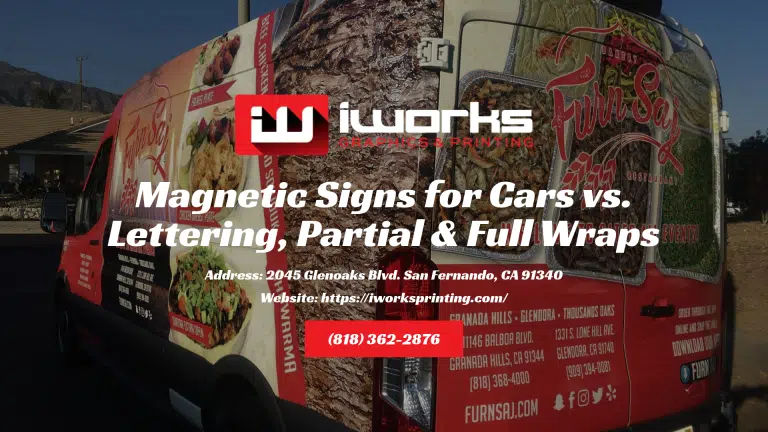
- Full wraps deliver bumper-to-bumper coverage for complete color changes or full branding on cars, vans, and box trucks.
- California B&P Code § 7029.6 requires licensed contractors to display their business name and license number on commercially registered vehicles.

What Are the Four Levels of Vehicle Branding Coverage?
Vehicle branding coverage falls into four levels, and each step up from magnetic signs for cars to a full wrap adds coverage area while giving up some removability.
| Coverage level | Coverage area | Attachment method | Removal | Panel limits | Common vehicles |
| Magnetic signs for cars | One flat panel per sign, 12 x 18 in to 24 x 36 in | 30 mil or 60 mil flexible magnetic sheeting | Lifts off by hand, no tools | Smooth ferrous steel only; no aluminum, fiberglass, plastic, curved, or ribbed panels | Car doors, truck doors, van panels, tailgates |
| Vinyl lettering | Business name, phone, website, license number | Adhesive-backed cut vinyl on paint or glass | Stays on full time; peels with heat | Smooth paint and glass; follows gentle curves | Contractor pickups, service vans, rear windows |
| Partial wrap | Targeted panels, accents, and lettering | Printed vinyl sealed under a protective overlaminate | Removable when compatible vinyl is properly installed | Selected panels; curves need conformable film | Doors, hoods, tailgates, trunk lids |
| Full wrap | Bumper-to-bumper, full-panel coverage | Printed vinyl post-heated into curves and recesses | Removable when compatible vinyl is properly installed | Compound curves need conformable cast film | Cars, vans, box trucks |
All four levels share one attribute set: coverage area, attachment method, removability, panel compatibility, and design space. Material and installation labor scale with the square footage of magnet sheeting or vinyl involved. That is why Imagination Works Graphics And Printing prices every vehicle graphics project by quote rather than by a published rate.
When Do Magnetic Signs for Cars Make the Most Sense?
Magnetic signs for cars make the most sense when a vehicle carries branding only during work hours, switches between personal and business use, or moves between drivers.
Imagination Works Graphics And Printing builds its car magnets from 30 mil (0.030 in) magnetic sheeting as standard. A 60 mil heavy-duty gauge covers larger panels, freeway-driven vehicles, and frequent-removal fleet use. A CMYK digital press prints the face at up to 1440 dpi, and a gloss or matte UV overlaminate protects the print from sun and routine outdoor wear. Reflective vinyl accents add after-dark visibility for service vehicles, and die-cut or contour cutting shapes a magnet to a logo instead of a plain rectangle.
Magnetic sheeting grips only smooth, clean, ferrous steel. Aluminum, fiberglass, plastic, and ribbed panels rule a magnet out, and a household refrigerator magnet confirms compatibility before ordering. Magnets also carry a care schedule. Flexible magnet manufacturer guidance recommends weekly removal to keep the vehicle and the magnetic sheet free of roadway debris, since trapped dirt can damage the finish. The same guidance calls for removing magnetic signs before a car wash and storing rolled magnets with the printed side out, standing on end to avoid flat spots.
A real estate agent’s personal sedan, a part-time catering car, and a shared pool vehicle all fit this profile. The magnet comes off after hours and moves to the next car when the vehicle changes.
When Does Vinyl Lettering Beat a Magnet?
Vinyl lettering beats a magnet when branding must stay on the vehicle full time, sit on glass or a non-steel panel, or meet a legal display requirement.
Cut vinyl lettering is plotted from solid-color adhesive film, weeded, and transferred onto the panel with application tape, so the letters bond without a background sheet. Lettering carries the essentials: business name, phone number, website, and license number. Because the vinyl bonds to the paint, lettering stays in place through daily use, while a magnet has to come off on a weekly schedule.
California law makes lettering a compliance question for contractors. C-36 plumbing, C-45 sign, and C-57 well-drilling contractors must display their business name, permanent business address, and license number on each side of every commercially registered business vehicle, in letters at least 1.5 inches high, under B&P § 7029.5. All other licensed contractors must display their business name and license number in a clearly visible location, in letters at least 72-point or 3/4 inch high and wide, under B&P § 7029.6. The Contractors State License Board (CSLB) is the authority on which display method satisfies each classification.
The shop includes lettering within its partial wrap coverage, so name and license-number lettering can be quoted alongside larger panel graphics.
What Does a Partial Wrap Cover?
A partial wrap covers targeted panels, accents, and lettering, typically doors, hoods, tailgates, and trunk lids, and leaves the rest of the factory paint exposed as part of the design. Every iWorks partial wrap uses the same components:
- Print: Full-color CMYK graphics print on high-performance vinyl.
- Protection: A protective overlaminate shields the print from UV exposure, abrasion, and road grime.
- Finish: A gloss, satin, or matte finish sets the final look.
- Design range: Partial coverage carries photos, gradients, and large brand graphics that cut lettering cannot reproduce.
- Brand match: A delivery van or shuttle that circulates near a store can carry the same look as the building’s wall graphics and window graphics.
That brand match lets retail businesses extend the storefront onto the road and tie the vehicle to the location customers already recognize.
When Is a Full Wrap Worth the Commitment?
A full wrap is worth its larger material and labor investment when every panel needs branding, a vehicle needs a complete color change, or a fleet needs one identity repeated across every unit.
A professional full-wrap installation follows a standard sequence across the vehicle graphics industry. Installers clean and decontaminate each panel, squeegee the film into compound curves using an air-release liner, post-heat the vinyl around curves and recesses, and finish the edges according to the film’s requirements. The shop provides on-site vehicle wrap installation for personal, commercial, and recreational vehicles across the San Fernando Valley and Los Angeles.
Film type matters most at this coverage level. Vinyl film manufacturers describe calendered vinyl as thicker and generally intended for flat surfaces, note that edge lift may occur when it is applied to curved surfaces, and rate it as more prone to shrinkage than cast vinyl. In practice, cast vinyl suits full wraps with compound curves, while calendered vinyl can suit flatter panels and shorter-term graphics.
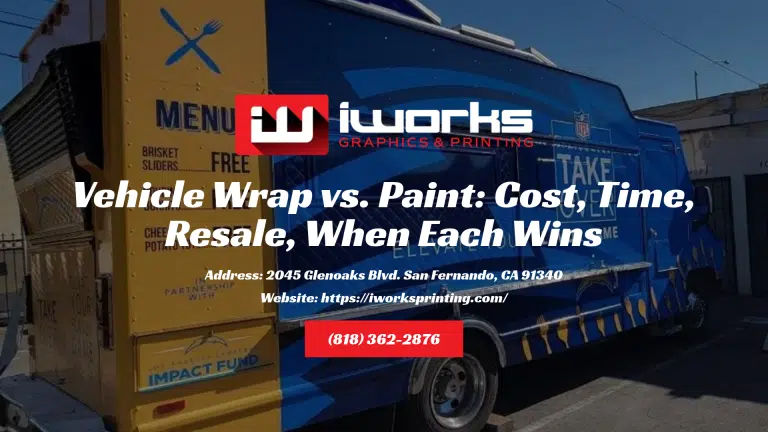
The shop wraps vehicles in six formats: full, partial, fleet, truck and trailer, boat and watercraft, and RV or bus. Fleet managers can request a single quote that covers the full rollout.
How Do Sun and Panel Angle Affect Each Option?
Sun exposure shortens the life of every coverage level, and manufacturer durability ratings drop sharply as a graphic tilts from a vertical door toward a flat hood or roof. One major wrap film manufacturer’s European product bulletin for cast print wrap film shows the gap clearly:
- Angle definitions: The bulletin defines vertical as a graphic face within 10° of vertical, horizontal as a face within 5° of horizontal, and non-vertical as everything in between.
- Durability by angle: In its mildest European climate zone, colored film rates 8 years vertical, 4 years non-vertical, and 2 years horizontal.
- Horizontal limits: Only certain film colors are listed as suitable for horizontal applications.
- Rating basis: The figures come from illustrative lab tests on unprocessed film and do not constitute warranties.
- Local scope: The bulletin assigns no zone to Southern California, so the figures show the effect of panel angle rather than a local lifespan.
- Magnet placement: Flexible magnet manufacturer guidance does not recommend horizontal placement such as a hood or roof.
For vehicles parked all day in open lots across the San Fernando Valley, overlaminate choice and panel placement carry more weight than they would on a garaged vehicle.
Which Coverage Fits Which Business?
The right coverage level depends on how long the branding must stay on, how many vehicles carry it, and which panels the vehicle offers.
| Business situation | Coverage that fits | Deciding factor |
| Real estate agent using a personal car | Magnetic signs for cars | Removes after work hours and moves to the next car |
| Licensed contractor with one work pickup | Vinyl lettering or partial wrap | Displays business name and CSLB license number full time |
| Retail store with a delivery van | Partial wrap | Matches storefront wall and window graphics |
| Fleet operator with vans and box trucks | Fleet wrap, full or partial | Standardizes logo placement, colors, and contact details across every unit |
| Plumbing, HVAC, landscaping, or electrical service | Partial or full wrap | Pairs the company name with a phone number and service list at every job site |
| Event organizer, food truck, RV, or bus | Full wrap | Large-format coverage carries branding to festivals, pop-ups, and grand openings |
| Startup or new business | Full or partial wrap | Gives a professional road presence without a recurring ad spend |
Expert Insight
“Our team collects your size, quantity, vehicle panel type, and print-ready file, then checks resolution, CMYK color mode, bleed, and safe-margin values. … The construction uses 30 mil (0.030 in) sheeting as standard and a 60 mil heavy-duty gauge for larger, freeway-driven panels. … The magnetic sheeting bonds only to smooth, clean, ferrous steel: car doors, truck doors, van panels, and tailgates. The material will not grip aluminum, fiberglass, plastic, or curved and ribbed panels, so a quick household-magnet test confirms compatibility before ordering.”
From the Imagination Works Graphics And Printing team
When a panel fails the magnet test, or the branding needs to stay on full time, vinyl lettering or a partial wrap bonds with adhesive and removes the steel requirement entirely.
What Artwork Files Does Each Coverage Level Need?
Every coverage level starts from print-ready artwork, and magnets carry the most precisely published file specs at Imagination Works Graphics And Printing. The requirements break down by coverage type:
- Car magnet file types: The shop accepts PDF, AI, EPS, PSD, JPG, PNG, and HEIC files up to 10 MB each.
- Car magnet resolution: Raster artwork should be prepared at 150 dpi at final size, or 300 dpi for small text.
- Car magnet setup: Files should use CMYK color mode, outlined or embedded fonts, a 0.125 to 0.25 in bleed, and a 0.25 in safe margin.
- Prepress and proofing: Prepress preflights the file, outlines fonts, corrects color, and sends a digital proof for sign-off before the layout goes to press.
- Wrap artwork: In-house designers build wrap layouts from scratch as print-ready vector artwork, working from photos of the vehicle and the business logo files.
- Lettering artwork: Cut lettering depends on vector artwork, because a vinyl plotter follows vector paths rather than pixels.
Clients who start with only a logo can use the shop’s in-house design support and online design tool to reach a print-ready file.
Get Your Coverage Quoted
Send Imagination Works Graphics And Printing your files: your logo or artwork, a photo of each side of the vehicle, and the panels you want covered. The shop confirms the right coverage level, magnet gauge or vinyl, and finish in your quote. Businesses ordering vehicle magnets in San Fernando, CA, can pick up finished magnets at 2045 Glenoaks Blvd., San Fernando, CA 91340, Monday to Friday, 9:00 AM to 5:00 PM.
Upload files through the quote form, email info@iworksprinting.com, or call (818) 362-2876.
Frequently Asked Questions
Do Magnetic Signs for Cars Stick to Aluminum or Fiberglass Panels?
Magnetic signs for cars do not stick to aluminum, fiberglass, or plastic panels, because flexible magnetic sheeting bonds only to ferrous steel. Some trucks and SUVs use aluminum or composite on certain body panels, so a household-magnet test on each target panel confirms compatibility. When a panel fails the test, vinyl lettering or a partial wrap bonds with adhesive instead and does not depend on the metal underneath.
Can Magnetic Signs for Cars Go on a Hood or Roof?
Magnetic signs for cars should not go on a hood or roof, because flexible magnet manufacturer guidance advises against horizontal placement, warning that plasticizers can migrate into the vehicle’s paint. Doors, tailgates, and flat side panels are the standard positions. Imagination Works Graphics And Printing produces magnets for flat steel doors and tailgates, and a hood or roof graphic is better handled as part of a partial or full wrap.
What Is the Difference Between Vinyl Lettering and a Partial Wrap?
Vinyl lettering applies individual cut letters and simple logos directly to the paint, while a partial wrap prints full-color graphics across whole panels such as doors, hoods, tailgates, or trunk lids. Lettering carries text and marks in solid colors. A partial wrap carries photos, gradients, and large brand graphics under an overlaminate. Imagination Works Graphics And Printing includes lettering within its partial wrap coverage, so both can be quoted together.
Can a Vehicle Wrap Be Removed Without Damaging the Paint?
A vehicle wrap can come off without damaging sound factory paint when the vinyl is compatible with the vehicle surface and properly installed. Cast vinyl can suit full wraps with compound curves, while calendered vinyl can suit flatter panels and shorter-term graphics. Paint condition before installation also matters, since adhesive can lift paint that is already chipped, peeling, or poorly bonded.
What Files Does Imagination Works Graphics And Printing Need for a Car Magnet?
Imagination Works Graphics And Printing accepts PDF, AI, EPS, PSD, JPG, PNG, and HEIC files up to 10 MB each for car magnets. Raster artwork should be prepared at 150 dpi at final size, or 300 dpi where small text appears. Files should use CMYK color mode, outlined or embedded fonts, a 0.125 to 0.25 in bleed, and a 0.25 in safe margin, and each job receives a digital proof before printing.
Do California Contractors Need Lettering on Their Work Vehicles?
Licensed California contractors must display their business name and license number in a clearly visible location on commercially registered vehicles, in letters at least 72-point or 3/4 inch high and wide, under Business and Professions Code § 7029.6. C-36 plumbing, C-45 sign, and C-57 well-drilling contractors must also show a permanent business address on each side, in letters at least 1.5 inches high, under § 7029.5. The CSLB publishes the current rules.
About Imagination Works Graphics And Printing
The Imagination Works Graphics And Printing team in San Fernando brings 20+ years of large-format and commercial printing expertise to vehicle magnets, producing 30 mil and 60 mil car magnets in-house alongside banners, signs, vehicle wraps, and business printing for clients across San Fernando, Sylmar, Burbank, Glendale, and Los Angeles.
Last updated: November 2026