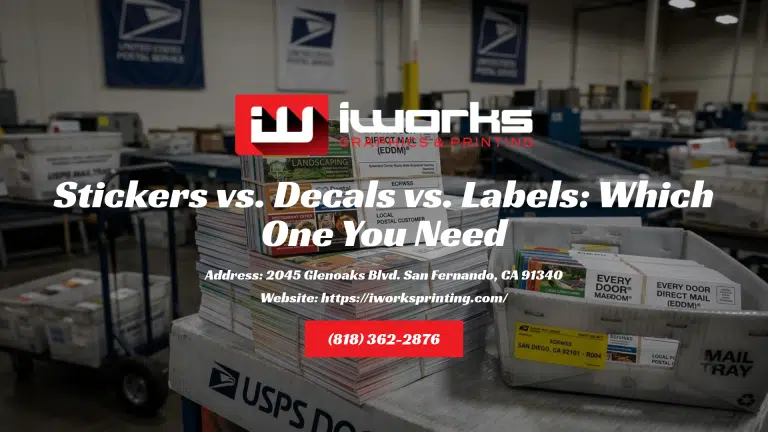
Decal vs. sticker vs. label comes down to layers and purpose. A sticker is a two-layer print that peels and sticks in one step, a decal adds a transfer-tape layer for glass, walls, and vehicles, and a label carries product information. Imagination Works Graphics And Printing in San Fernando, CA, brings 20+ years of print experience to all three.
Key Takeaways
- A standard sticker has two layers, face stock and liner; a transfer decal adds a third layer of application tape on top.
- Film makers rate calendered vinyl at roughly 3 to 8 years outdoors and 2 mil cast vinyl at roughly 7 to 12 years.
- FDA rules in 21 CFR Part 101 require packaged-food labels to show the product name and net quantity on the front panel.
- California Vehicle Code Section 26708 allows stickers in a 7-inch square in the lower corner of the windshield or rear window farthest from the driver, or a 5-inch square in the lower windshield corner nearest the driver.
- Imagination Works Graphics And Printing offers three cut formats (die-cut, kiss-cut, and contour-cut) with local pickup and nationwide shipping.

What Is the Difference Between a Decal and a Sticker?
A sticker is a two-layer product that peels off its liner and sticks in one motion, while a decal uses a third layer, transfer tape, to move the graphic onto a surface. The extra layer exists because many decals are cut vinyl lettering or logos with no background, so each letter would fall loose without a carrier sheet holding the spacing.
A sticker’s printed face sits on top of its adhesive as one solid piece. A die-cut sticker trims the face and liner to the artwork’s outline, and a kiss-cut sticker cuts through the face only, leaving the liner intact as a sheet. A contour cut follows the vector outline of the artwork, so a sticker or decal can take any custom shape instead of a stock rectangle or circle. Both formats hand over a single object that goes straight onto a laptop, water bottle, or shipping box.
A decal works differently. A vinyl cutter scores the design into colored film, weeding removes the excess vinyl around each shape, and a sheet of application tape lifts the finished letters off the liner as one unit. The decal then transfers to glass, a painted panel, or a wall, and the tape peels away, leaving only the vinyl shapes behind. That is why cut vinyl decals look painted on: no clear or white border surrounds the design.
The terms overlap in everyday use. Many printers sell full-color, die-cut vinyl pieces as “decals,” and car-culture buyers call almost anything on a bumper a sticker. Construction, not the product name on a price list, is the reliable test: two layers means sticker behavior; three layers means decal behavior.
Where Do Labels Fit In?
A label is an adhesive print whose main job is to carry information, such as a product name, ingredients, barcode, or shipping address, rather than to decorate or brand a surface. Labels usually run in simple shapes (rectangles, circles, and ovals) and often ship on rolls so packaging lines or hand-labelers can apply them quickly.
Regulation shapes many labels. For packaged food sold in the United States, FDA rules in 21 CFR Part 101 require a statement of identity and the net quantity of contents on the principal display panel, while the ingredient list, nutrition facts, and the name and address of the manufacturer or distributor may appear on either the principal display panel or the information panel. A decorative sticker carries no such requirement, which is the clearest functional line between the two products.
Label stock depends on the container. Paper labels suit dry goods such as boxed products and bakery bags, while vinyl or clear film labels hold up on bottles, cans, and jars that sweat in a cooler or go through condensation.
Stickers vs. Decals vs. Labels: Side-by-Side Comparison
The comparison table below sorts the three products by construction, application, and typical use, the three attributes that decide most orders.
| Attribute | Sticker | Decal | Label |
| Layers | Two: printed face and liner | Three: vinyl, liner, and transfer tape | Two: printed face and liner |
| Primary job | Branding, decoration, giveaways | Lettering and logos on glass, walls, vehicles | Product, packaging, and shipping information |
| Typical material | Vinyl, paper, or clear film | Cut vinyl, printed vinyl, or perforated window film | Paper, vinyl, or clear film |
| Common cut | Die-cut or kiss-cut | Contour-cut and weeded | Die-cut on rolls or sheets |
| Application | Peel and stick in one step | Position with transfer tape, squeegee, peel tape | Peel and stick, by hand or applicator |
| Background | Visible border or shape | No background around letters | Visible label shape |
| Common use | Laptops, water bottles, trade show bags | Storefront hours, fleet van doors, office walls | Jars, bottles, boxes, mailers |
Which Materials Do Stickers, Decals, and Labels Use?
Three materials cover most adhesive print work: paper, calendered vinyl, and cast vinyl, each matched to a different lifespan and surface.
Paper stock prints sharp color at low cost but absorbs water, so paper stickers and labels belong on dry, indoor items such as product boxes, notebooks, and event name tags. Calendered vinyl is rolled and stretched into a sheet about 2.5 to 4 mil thick, and that manufacturing tension makes it best for flat surfaces such as storefront glass and smooth signs. Cast vinyl is poured as a liquid into a film about 2 mil thick, so it carries no built-in tension and conforms to rivets, curves, and recessed vehicle panels.
Clear vinyl gives jar and bottle labels a no-label look, and perforated window film prints a full graphic on the outside of glass while the tiny holes keep the view open from inside. Laminate adds a final protective layer: a gloss, matte, or luster overlaminate shields printed ink from scuffs, cleaning, and UV fading.
Adhesive matters as much as face stock. Permanent adhesive suits packaging seals and long-term branding, removable adhesive suits short campaigns and rented spaces, and an air-release liner leaves tiny channels in the adhesive that let trapped air escape on larger decals.
How Long Do Stickers and Decals Last Outdoors?
Outdoor life depends on the vinyl grade more than the product name: manufacturer data sheets typically rate calendered films at about 3 to 8 years and premium 2 mil cast films at about 7 to 12 years.
Those ratings come with conditions. Vinyl makers test films in vertical exposure, such as a window or a van door, in a temperate climate, and data sheets typically list shorter ratings for horizontal surfaces, south-facing installs, and hot, high-UV regions. A hood decal or a sign facing afternoon sun in the San Fernando Valley sits in exactly those harsher conditions. Metallic and specialty colors usually carry shorter ratings than black-and-white film.
Paper stickers are an indoor product and lose color and structure quickly once rain or sprinklers reach them. Treat any year figure as a material rating, not a promise for a specific job: ink type, laminate, surface prep, and cleaning habits all move the real number.
How Are Stickers and Decals Applied?
Stickers apply in one step, peel and press, while decals apply in four: position, hinge, squeegee, and release the transfer tape.
A sticker needs a clean, dry, smooth surface and firm pressure from the center outward. A decal installation starts with cleaning the surface, often with isopropyl alcohol, then taping the decal in place along one edge as a hinge. The installer peels the liner back, presses the vinyl down with a squeegee in overlapping strokes, and pulls the transfer tape back at a sharp angle so the letters stay on the surface.
Larger graphics change the method. Wet application, a light spray of soapy water, lets an installer slide a big decal into position on glass, while air-release vinyl is built for dry application on painted panels. Wall decals and vehicle graphics above a few feet wide usually call for a second set of hands or professional installation, because a crooked first placement is hard to correct once the adhesive grabs.
Can Stickers or Decals Go on a Car Window in California?
California Vehicle Code Section 26708 generally bars materials on a vehicle’s windshield and windows, with an exception for signs and stickers inside a 7-inch square in the lower corner of the windshield or rear window farthest from the driver or a 5-inch square in the corner nearest the driver.
The same section exempts side windows behind the driver, and it allows rear window graphics when the vehicle has outside mirrors on both sides. That is why fleet decals and perforated rear window graphics in California sit on rear and rear-side glass. Read the current text of the code on the California Legislative Information site before installing anything on a vehicle, since this section has been amended several times.
Which One Does Your Project Need?
The right product follows the surface, the lifespan, and the job the graphic has to do, as the use-case guide below shows.
| Project | Best fit | Why |
| Trade show giveaways, festival swag | Die-cut vinyl sticker | Full-color art, one-step application, survives bags and water bottles |
| Jars, bottles, and cans in a cooler | Clear or white vinyl label with laminate | Resists condensation and carries product information |
| Shipping boxes and mailers | Paper or vinyl label on rolls | Low cost per piece, fast to apply in volume |
| Storefront hours and logo on glass | Cut vinyl decal | Letters with no background read as painted on |
| Full-color window promotion | Perforated window film | Graphic outside, clear view from inside |
| Fleet van doors and tailgates | Cast or calendered vinyl decal, matched to the panel shape | Cast vinyl conforms to curves and rivets |
| Classroom or office wall lettering | Removable vinyl wall decal | Comes off when the room changes |
In practice, storefront hours and full-color promotions on glass run as window graphics, classroom and office lettering runs as wall graphics, and fleet van door lettering often pairs with full or partial vehicle wraps.
Expert Insight
“The surface and the lifespan should decide the format before the artwork does. A water bottle, a storefront window, and a jar on a retail shelf each call for a different material, adhesive, and cut, even when the logo is the same. Before any sticker or decal runs, our team reviews the vector or 300 dpi files, confirms bleed and CMYK build, and sends a digital proof for approval.”
From the Imagination Works Graphics And Printing Team
Ready to Print? Send Your Files
Artwork in hand and the format decided? Send Imagination Works Graphics And Printing your files in AI, EPS, PDF, SVG, PNG, JPEG, or PSD format, along with the surface, size, and quantity, and the team returns a digital proof before anything goes to press. Vector files cut cleanest for decals, and raster files print best at 300 dpi.
Explore decal printing and sticker printing in San Fernando, CA, including die-cut singles, kiss-cut sheets, and roll labels for local pickup or nationwide shipping.
Frequently Asked Questions
Is a Decal the Same as a Sticker?
A decal is not the same as a sticker: a decal uses three layers, including transfer tape, while a sticker uses two and applies in one step. The transfer tape holds cut vinyl letters in their spacing so they can move onto glass, walls, or vehicle panels without a background. Many printers still label full-color vinyl pieces as decals, so ask how the product is built rather than relying on the name.
Are Vinyl Stickers Waterproof?
Vinyl stickers resist water because PVC film does not absorb moisture the way paper does. That makes vinyl the standard choice for water bottles, coolers, and outdoor gear, while paper stickers suit dry, indoor items only. A gloss, matte, or luster laminate adds a second layer of protection against scuffs and UV fading, and permanent adhesive holds better than removable adhesive through repeated washing.
Can I Put a Decal on My Car Window in California?
California Vehicle Code Section 26708 allows windshield stickers only in a 7-inch square in the lower corner of the windshield or rear window farthest from the driver or a 5-inch square in the corner nearest the driver. Side windows behind the driver are exempt, and rear window graphics are allowed when the vehicle has outside mirrors on both sides. Check the current code text before installing, because the section has been amended several times.
What Is the Difference Between a Label and a Sticker?
A label carries information, while a sticker carries branding or decoration, even though both use the same two-layer construction. Food labels in the United States must follow FDA rules in 21 CFR Part 101, which require the product name and net quantity on the front panel. Labels usually run in simple shapes on rolls for fast application, while stickers are often die-cut to a custom outline.
What File Format Is Best for Decal Printing?
Vector formats such as AI, EPS, SVG, and PDF are best for decal printing because a vinyl cutter follows vector paths to cut each letter and shape. Raster files such as PNG, JPEG, and PSD work for printed stickers when they are built at 300 dpi at final size. Fonts should be converted to outlines, and artwork for full-bleed stickers should extend past the cut line so no white edge shows.
Do Vinyl Decals Damage Car Paint?
Vinyl decals on factory-cured paint usually remove cleanly with gentle heat from a hair dryer and a plastic scraper, and any leftover adhesive comes off with an adhesive remover. Paint under a decal fades less than the surrounding paint, so a decal left on for years can leave a visible outline. Repainted or poorly bonded paint can lift with the adhesive, so test a corner first.
About Imagination Works Graphics And Printing
Imagination Works Graphics And Printing is a San Fernando, CA team with 20+ years of large-format and commercial printing experience. Its decal and sticker printing covers die-cut, kiss-cut, and contour-cut vinyl, plus window, wall, and vehicle graphics, for customers across the San Fernando Valley, Burbank, Glendale, and Santa Clarita.
Last updated: November 2026