The standard flyer size in the US is 8.5 x 11 inches, with the 5.5 x 8.5-inch half sheet as the compact option. Business cards trim to 3.5 x 2 inches, postcards to 4 x 6 inches, and #10 envelopes to 4.125 x 9.5 inches. Imagination Works Graphics And Printing in San Fernando, CA, preflights every size in-house before printing.
Key Takeaways
- US Letter flyers measure 8.5 x 11 inches, and half-sheet flyers measure 5.5 x 8.5 inches, using exactly half the paper.
- A standard US business card trims to 3.5 x 2 inches, while European business cards commonly measure 85 x 55 mm.
- USPS retail postcard prices cover cards from 3.5 x 5 inches up to 4.25 x 6 inches, 0.007 to 0.016 inches thick.
- A #10 envelope at 4.125 x 9.5 inches holds an 8.5 x 11 letter or trifold brochure folded into thirds.
- Print files at every size need 0.125-inch bleed per edge, 300 DPI images, and CMYK color.

Flyer Size: What Are the Standard Dimensions?
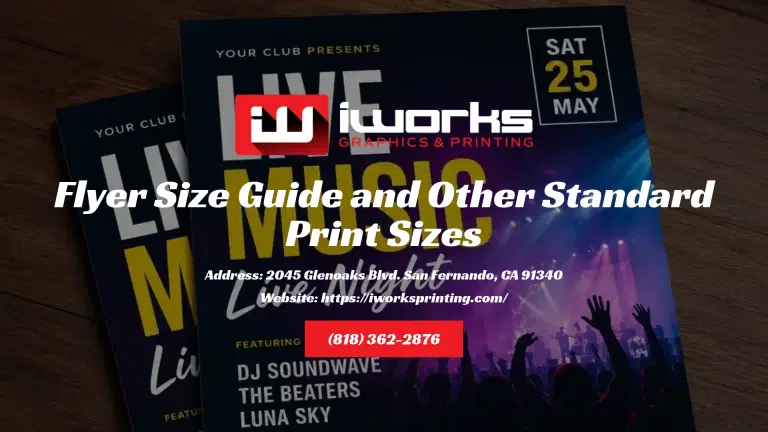
The standard flyer size in the United States is 8.5 x 11 inches (US Letter), followed by the 5.5 x 8.5-inch half sheet and the 4.25 x 5.5-inch quarter sheet.
| Flyer Size | Trim Dimensions | Pixels at 300 DPI (Trim) | Typical Use |
| Quarter sheet | 4.25 x 5.5 in | 1275 x 1650 px | Counter handouts, coupons |
| Half sheet | 5.5 x 8.5 in | 1650 x 2550 px | Event handouts, single-offer promotions |
| US Letter | 8.5 x 11 in | 2550 x 3300 px | Menus, price lists, bulletin boards |
| Legal | 8.5 x 14 in | 2550 x 4200 px | Event schedules, multi-item price lists |
| Tabloid | 11 x 17 in | 3300 x 5100 px | Storefront windows, event boards |
| Rack card | 4 x 9 in | 1200 x 2700 px | Lobby and visitor-center display racks |
The quarter, half, and letter flyer sizes all divide evenly from one 8.5 x 11 sheet. A half sheet uses exactly half of an 8.5 x 11 sheet, and a quarter sheet uses one quarter, so both sizes print two-up or four-up and cut down without waste. A tabloid flyer equals two letter sheets placed side by side, which doubles the viewing area for window and wall display. Displays larger than 11 x 17 inches move into poster printing sizes such as 18 x 24 and 24 x 36 inches.
Imagination Works Graphics And Printing lists 8.5 x 11 and 5.5 x 8.5 inches as its standard flyer sizes, printed in full-color CMYK as single-sided (4/0) or double-sided (4/4) layouts. The “4/0” label means four ink colors on the front and none on the back. The shop’s paper printing spec sheet lists 80 lb to 100 lb gloss text stock for flyers, with matte, gloss, silk, and UV coating as finish options.
International Flyer Sizes: A4, A5, and A6
ISO 216 defines A4 as 210 x 297 mm, A5 as 148 x 210 mm, and A6 as 105 x 148 mm, with each size exactly half of the size before it.
| ISO Size | Millimeters | Inches | Pixels at 300 DPI (Trim) |
| A4 | 210 x 297 mm | 8.27 x 11.69 in | 2480 x 3508 px |
| A5 | 148 x 210 mm | 5.83 x 8.27 in | 1748 x 2480 px |
| A6 | 105 x 148 mm | 4.13 x 5.83 in | 1240 x 1748 px |
A4 runs 5.9 mm narrower and 17.6 mm taller than US Letter, so a Letter layout cannot simply be rescaled to A4 without cropping or reflowing text. A campaign printed for both US and international audiences therefore needs a separate file for each size.
What Size Is a Standard Business Card?
A standard US business card measures 3.5 x 2 inches (88.9 x 50.8 mm) after trimming.
| Business Card Format | Dimensions | File Size With Bleed | Pixels With Bleed (300 DPI) |
| US and Canada standard | 3.5 x 2 in | 3.75 x 2.25 in | 1125 x 675 px |
| Common European size | 85 x 55 mm | 91 x 61 mm (3 mm bleed) | Set per printer template |
| Credit card (ISO/IEC 7810 ID-1) | 85.60 x 53.98 mm | Reference size only | Not a print standard |
North American printers treat the 3.5 x 2-inch card as the default trim, and the size fits standard wallets and card holders. European cards commonly measure 85 x 55 mm, a slightly narrower and taller shape, so a US layout needs its own European version rather than a stretched copy. Card thickness is measured in points, where 1 pt equals 0.001 inch, so a 16 pt card is 0.016 inch thick.
Imagination Works Graphics And Printing produces business cards at 3.5 x 2 inches on 14 pt or 16 pt cover stock. The shop’s business card page lists four finishes (matte, gloss, silk lamination, and UV coating) and square or rounded corners.
Brochure Size: What Are the Standard Dimensions?
The most common brochure size is an 8.5 x 11-inch flat sheet folded into a trifold of six panels, each roughly 3.67 x 8.5 inches.
| Flat Size | Fold Style | Finished Size | Panels |
| 8.5 x 11 in | Trifold (letter fold) | About 3.67 x 8.5 in | 6 |
| 8.5 x 11 in | Z-fold | About 3.67 x 8.5 in | 6 |
| 8.5 x 11 in | Bifold (half fold) | 5.5 x 8.5 in | 4 |
| 11 x 17 in | Bifold (half fold) | 8.5 x 11 in | 4 |
| 11 x 17 in | Trifold | About 5.67 x 11 in | 6 |
The standard trifold brochure size is 8.5 x 11 inches flat and about 3.67 x 8.5 inches folded. A trifold, also called a letter fold, rolls two outer panels inward, so the panel that tucks inside is built slightly narrower to fold flat. A Z-fold zigzags like an accordion, with all three panels at equal width and the inside spread visible in one pull. A bifold folds once down the middle, turning an 11 x 17 sheet into a letter-size booklet of four pages.
The shop’s spec sheet lists brochures at 8.5 x 11 or 11 x 17 inches flat on 100 lb gloss text, with bifold, trifold, or Z-fold options. Heavier stocks are usually scored before folding, which presses a crease line into the sheet so the fold stays clean instead of cracking the ink.
What Size Is a Standard Postcard?
The standard postcard size is 4 x 6 inches, and USPS retail postcard prices apply only to cards between 3.5 x 5 and 4.25 x 6 inches, 0.007 to 0.016 inches thick.
| Postcard Size | USPS Retail Classification | Commercial First-Class Presort | File Size With Bleed | Pixels With Bleed |
| 4 x 6 in | Postcard | Postcard | 4.25 x 6.25 in | 1275 x 1875 px |
| 4.25 x 6 in | Postcard (maximum) | Postcard | 4.5 x 6.25 in | 1350 x 1875 px |
| 5 x 7 in | Letter | Postcard if 0.009 to 0.016 in thick | 5.25 x 7.25 in | 1575 x 2175 px |
| 6 x 9 in | Letter | Postcard (maximum) if 0.009 to 0.016 in thick | 6.25 x 9.25 in | 1875 x 2775 px |
USPS expanded commercial presorted and automation First-Class postcards to a maximum of 6 x 9 inches, with a 0.009-inch minimum thickness for cards larger than 4.25 x 6 inches. Retail single-piece cards still top out at 4.25 x 6 inches, so a 5 x 7 or 6 x 9 card dropped at a post office counter pays the letter price. A 14 pt card measures 0.014 inches and a 16 pt card measures 0.016 inches, which places 16 pt stock right at the USPS ceiling, so laminated or heavily coated cards need a thickness check before mailing.
The iWorks spec sheet lists postcards at 4 x 6, 5 x 7, or 6 x 9 inches on 14 pt or 16 pt cover stock, with a full-color front and a mailing-panel back.
EDDM Postcard Size Requirements
Every Door Direct Mail (EDDM) pieces must qualify as USPS flats, and the simplest EDDM postcard size clears that bar by standing taller than 6.125 inches, up to a 12 x 15-inch maximum.
A 6.25 x 9, 6.5 x 9, or 8.5 x 11-inch mailer clears the 6.125-inch height threshold, which explains why those three sizes appear on EDDM spec sheets, including the iWorks spec sheet. A 4 x 6 postcard does not qualify for EDDM because it stays inside letter-size limits. EDDM reaches every address on a selected USPS carrier route without a mailing list.
What Are the Standard Envelope Sizes?
The #10 envelope, at 4.125 x 9.5 inches, is the standard US business envelope and holds an 8.5 x 11 sheet folded into thirds.
| Envelope | Dimensions | Holds |
| #9 | 3.875 x 8.875 in | Reply envelope that nests inside a #10 |
| #10 | 4.125 x 9.5 in | Trifold letterhead, trifold 8.5 x 11 brochures |
| A2 | 4.375 x 5.75 in | 4.25 x 5.5 quarter-sheet cards and RSVP cards |
| A7 | 5.25 x 7.25 in | 5 x 7 invitations and cards |
| 6 x 9 booklet | 6 x 9 in | 5.5 x 8.5 half sheets, letters folded once |
| 9 x 12 catalog | 9 x 12 in | Unfolded 8.5 x 11 documents |
| DL (ISO 269) | 110 x 220 mm | A4 folded into thirds |
| C5 (ISO 269) | 162 x 229 mm | A5 flat, or A4 folded once |
| C6 (ISO 269) | 114 x 162 mm | A6 flat, or A4 folded twice |
Envelope size also decides the USPS mail category. Letter-size mail tops out at 6.125 x 11.5 inches and 0.25 inch thick, so a #10, A7, or 6 x 9 envelope mails as a letter, while a 9 x 12 catalog envelope mails as a flat. USPS machinable letters need an aspect ratio (length divided by height) between 1.3 and 2.5, which makes square envelopes, at a ratio of 1, nonmachinable.
The shop’s business stationery spec pairs 8.5 x 11-inch letterhead with a matching #10 envelope, the standard pairing for US business correspondence.
How Should a Print File Be Set Up at Any Size?
A print-ready file at any trim size carries 0.125 inch of bleed on every edge, keeps text inside a safe area at least 0.125 inch from the trim, and uses 300 DPI images in CMYK color.
Bleed extends background color and images past the cut line, so a small shift at the trimmer leaves no white sliver on the finished edge. The math stays the same at every size: the file adds 0.25 inch to each trim dimension, and pixel dimensions equal inches multiplied by 300. A 5.5 x 8.5-inch half-sheet flyer, for example, becomes a 5.75 x 8.75-inch file at 1725 x 2625 pixels.
Vector logos saved as AI, EPS, or PDF keep sharp edges at any size, while raster photos need full resolution at the final printed size. Pantone (PMS) spot colors convert to CMYK for process printing, which can shift a brand color, so a proof confirms the result before the full run. Imagination Works Graphics And Printing preflights each file for bleed, safe margins, resolution, trim, and CMYK color mode before production.
Standard Print Size Cheat Sheet
The table below lists trim size, file size with bleed, and pixel dimensions at 300 DPI for every US format in this guide.
| Product | Trim Size | File Size With 0.125 in Bleed | Pixels at 300 DPI (With Bleed) |
| Business card | 3.5 x 2 in | 3.75 x 2.25 in | 1125 x 675 px |
| Quarter-sheet flyer | 4.25 x 5.5 in | 4.5 x 5.75 in | 1350 x 1725 px |
| Half-sheet flyer | 5.5 x 8.5 in | 5.75 x 8.75 in | 1725 x 2625 px |
| Letter flyer or flat brochure | 8.5 x 11 in | 8.75 x 11.25 in | 2625 x 3375 px |
| Tabloid flyer or flat brochure | 11 x 17 in | 11.25 x 17.25 in | 3375 x 5175 px |
| Rack card | 4 x 9 in | 4.25 x 9.25 in | 1275 x 2775 px |
| Postcard | 4 x 6 in | 4.25 x 6.25 in | 1275 x 1875 px |
| Postcard | 5 x 7 in | 5.25 x 7.25 in | 1575 x 2175 px |
| Postcard | 6 x 9 in | 6.25 x 9.25 in | 1875 x 2775 px |
| EDDM mailer | 6.25 x 9 in | 6.5 x 9.25 in | 1950 x 2775 px |
| EDDM mailer | 6.5 x 9 in | 6.75 x 9.25 in | 2025 x 2775 px |
Pixel values are calculated as file size in inches multiplied by 300. Printer templates can differ slightly, so the template supplied with a quote takes priority over any general chart.
Expert Insight
“A print size problem is easiest to fix before production, not after. Our team preflights each upload for bleed, safe margins, resolution, trim, and CMYK color, so a business card built without its 0.125-inch bleed or a Letter flyer resized to A4 gets flagged at the proof stage instead of at the trimmer.”
From The Imagination Works Graphics And Printing Team
Which Print Size Fits Which Job?
Distribution method decides print size: handouts favor 5.5 x 8.5 or 4.25 x 5.5 inches, mail favors 4 x 6 to 6 x 9-inch postcards, and windows favor 11 x 17 inches.
| Job | Recommended Size | Reason |
| Grand opening street handout | 5.5 x 8.5 in half-sheet flyer | One offer fits, and two flyers can be cut from each letter sheet |
| Restaurant takeout menu | 8.5 x 11 in flyer, 4/4 | Two full sides carry a complete menu |
| Trade show leave-behind | 8.5 x 11 in trifold brochure | Six panels, and the folded piece fits a #10 envelope |
| Appointment or reminder mailer | 4 x 6 in postcard | Stays inside the USPS retail postcard size limit |
| Neighborhood saturation mailing | 6.5 x 9 in EDDM mailer | Clears the 6.125-inch USPS flat threshold |
| Storefront window or classroom board | 11 x 17 in tabloid flyer | Twice the area of a letter sheet for distance reading |
Business cards, letterhead, and #10 envelopes share one brand layout, and Imagination Works Graphics And Printing groups those formats with flyers, brochures, postcards, presentation folders, and EDDM mailers in one order. USPS publishes current mailing standards in its Quick Service Guide 201 and its PostalPro Larger Sized Postcard FAQs.
Send Your Files for a Size-Checked Quote
Send Imagination Works Graphics And Printing your files with four details (finished size, quantity, paper stock, and finish), and the team preflights the artwork for bleed, safe margins, resolution, and CMYK color before confirming the quote. Every flyer size, paper stock, and finish covered in this guide is available through the shop’s flyer printing service in San Fernando, CA, along with a print-ready file checklist. Size questions on a specific job go to (818) 362-2876.
Frequently Asked Questions
What Is the Most Common Flyer Size?
The most common flyer size in the US is 8.5 x 11 inches, the same size as a sheet of US Letter paper. The 5.5 x 8.5-inch half sheet ranks as the main alternative for handouts, because two half sheets can be cut from one letter sheet. Content-heavy pieces such as menus and price lists stay on letter size, while single-offer promotions fit the half sheet.
Is A4 the Same Size as US Letter?
A4 is not the same size as US Letter: A4 measures 210 x 297 mm, while Letter measures 8.5 x 11 inches, or 215.9 x 279.4 mm. A4 runs 5.9 mm narrower and 17.6 mm taller, so a layout built for one size crops or leaves white space on the other. An A4 version therefore needs its own file rather than a rescaled Letter file.
What Envelope Size Fits a Trifold Brochure?
A #10 envelope, at 4.125 x 9.5 inches, fits a standard trifold brochure made from an 8.5 x 11-inch sheet. The folded brochure measures roughly 3.67 x 8.5 inches, which leaves clearance on every side for insertion. For metric A4 brochures folded into thirds, the matching envelope is the DL size defined in ISO 269, which measures 110 x 220 mm.
Can a 6 x 9 Postcard Mail at Postcard Prices?
A 6 x 9 postcard mails at First-Class card prices only as commercial presorted or automation mail, and only when the card is 0.009 to 0.016 inch thick, under current USPS standards. At a retail post office counter, any card larger than 4.25 x 6 inches pays the letter price. USPS revises prices and standards periodically, so current rules on USPS Postal Explorer take priority over any printed guide.
How Much Bleed Does a Print File Need?
Most print files need 0.125 inches, or about 3 mm, of bleed on each edge whenever color or images run to the trim line. A 3.5 x 2-inch business card file therefore measures 3.75 x 2.25 inches, and an 8.5 x 11-inch flyer file measures 8.75 x 11.25 inches. The extra margin absorbs small cutting shifts, so no white sliver appears on the finished piece.
What Flyer Size Works for EDDM?
EDDM mailers must qualify as USPS flats, and the simplest route is a piece taller than 6.125 inches, such as 6.25 x 9, 6.5 x 9, or 8.5 x 11 inches. The maximum EDDM flat measures 12 x 15 inches. A standard 4 x 6 postcard does not qualify because it stays within USPS letter-size limits and never crosses the flat threshold.
About Imagination Works Graphics And Printing
The Imagination Works Graphics And Printing team brings 20+ years of experience to flyer printing in San Fernando, CA, producing full-color 4/0 and 4/4 flyers in-house with preflighted artwork. The team also prints banners, signs, and business collateral across the San Fernando Valley and Los Angeles.
Last updated: November 2026